Crypto market analysis today starts with breadth, volume, and liquidity. Use six signals to separate a routine pullback from a fragile altcoin move.

Aria Chen
Lead Quantitative Analyst
One violent token move does not prove that the whole market has changed. It can reflect a token-specific event, a thin order book, or a bad reference price. The useful question is narrower: are losses broad enough, active enough, and persistent enough to change the risk of holding or trading smaller assets?
This guide turns crypto market analysis today into six checks that can be repeated with a timestamp. It does not predict prices or identify assets to buy. It helps readers distinguish a noisy session from a market in which weak liquidity can turn a normal sell-off into an outsized loss.
Start with the market's shape, not its loudest headline. CoinGecko's markets endpoint exposes price, market cap, trading volume, rank, and change fields together. That matters because a percentage move without rank or turnover says little about how widely the move is shared.
The July 22 snapshot offered a mixed but defensive cross-section. The seven tracked sectors were all lower: Store of Value averaged -0.7%, Gaming -1.0%, Layer 2 -1.3%, Meme -1.5%, DeFi -1.9%, Layer 1 -2.0%, and AI -2.3%. Those figures do not establish a trend by themselves. They do show why a reader should avoid treating one green token as proof of broad risk appetite.
Breadth asks how many parts of the market participate in a move. Count sectors, market-cap groups, and liquid pairs rather than counting social posts. In this snapshot, all seven tracked sectors were negative, and the average loss widened from -0.7% in Store of Value assets to -2.3% in AI tokens. That is a breadth signal, not a forecast.
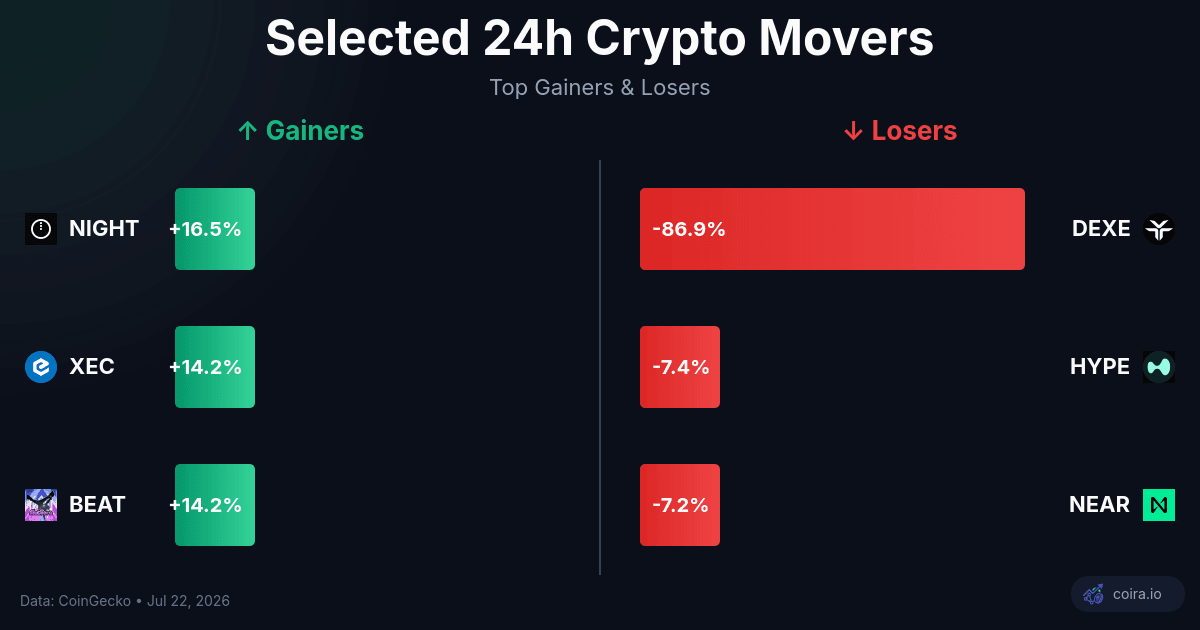
Then separate large, liquid assets from smaller ones. Hyperliquid ranked 10th by market cap in the same data and was down 7.4%. NEAR ranked 38th and was down 7.2%. DeXe ranked 152nd and was down 86.9%. A 12-fold difference in percentage loss between DeXe and Hyperliquid should prevent a simple conclusion such as "altcoins are down 7%."
Crypto market analysis today should also note exceptions. Midnight rose 16.5%, eCash rose 14.2%, and Audiera rose 14.2% in the same 24-hour window. Three gainers do not cancel broad weakness. They tell the analyst to inspect token-specific news, circulating supply, venue concentration, and whether the displayed volume can support a meaningful exit.
Volume is evidence of activity, not proof of healthy liquidity. DeXe's reported 24-hour volume was about $248.3 million against a market cap near $231.4 million. That ratio merits caution: it can occur during genuine repricing, but it can also make a displayed percentage move harder to interpret without checking the venues and order books behind it.
For comparison, Hyperliquid recorded roughly $406.5 million in 24-hour volume with a $13.0 billion market cap. NEAR recorded about $200.2 million in volume with a $2.44 billion market cap. The point is not that one ratio is automatically safe. It is that crypto market analysis today needs to ask whether a quoted price represents broad, executable interest or a stressed market with uneven depth.
The live CoinGecko market feed supplies those market-cap and 24-hour-volume fields together. Use both. A market-cap ranking is a starting point, not a liquidity guarantee.
Use a short checklist after any outlier appears:
This is more durable than a one-line market call. Readers who want to apply the same discipline to individual tokens can use Coira's due-diligence checklist, compare the market health dashboard, and review the Hyperliquid analysis. For broader context on deleveraging, see our guide to a futures unwind.
Treat a broad negative sector snapshot as evidence of higher short-term market risk, not as a prediction. If losses remain broad across the next two daily observations and volume rises in several liquid assets, update the risk assessment and verify the cause with primary project or exchange notices. If the move stays concentrated in one low- or mid-ranked token, investigate that token's supply, venues, and announcements before generalizing it to the market.
Crypto market analysis today earns its value when it records the timestamp, compares like with like, and leaves room for disconfirming evidence. That makes the next check more useful than the first reaction.
Disclaimer: This article is for informational purposes only and does not constitute financial advice. Cryptocurrency investments carry significant risk. Always conduct your own research and consult with a qualified financial advisor before making investment decisions.
Market analysis and actionable insights. No spam, ever.
