
DeFi Derivatives Defy Gravity as Crypto Market Capitulates
Hyperliquid and MYX Finance surge while Bitcoin crashes 15%. Why derivatives platforms are the rare winners in February's extreme fear selloff.

Contents
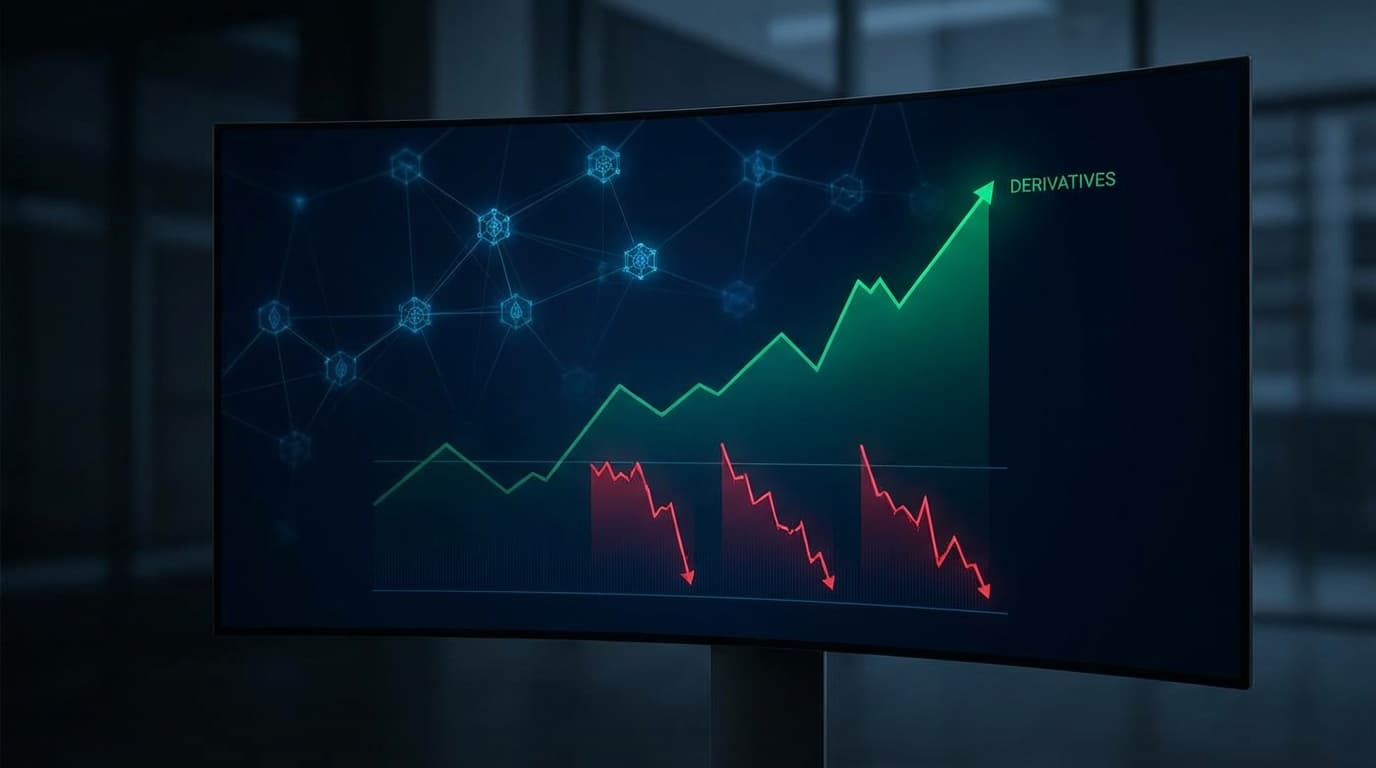
While Bitcoin plunges 15% in its worst drawdown since FTX and the Fear & Greed Index hits 9, DeFi derivatives platforms are posting gains. Hyperliquid rose 4% and MYX Finance climbed higher. Here's why smart money is rotating into derivatives infrastructure during the carnage.
The Great Divergence
February 2026 will be remembered as a capitulation event. Bitcoin crashed from $120,000 in October to briefly touch $60,000, while the total crypto market cap collapsed from $4.38 trillion to $2.3 trillion. The Fear & Greed Index hit 9, matching FTX-era lows.
Yet amid this destruction, two assets moved in the opposite direction. Hyperliquid (HYPE) gained 3.96% and MYX Finance climbed 4.13% in 24 hours. This isn't random, it reveals a structural shift in how sophisticated capital behaves during market stress.
Why Derivatives Platforms Outperform
Traditional logic suggests everything falls together during panic. But DeFi derivatives platforms benefit from three counter-intuitive dynamics:
1. Revenue Accrual, Not Speculation
Hyperliquid generates protocol revenue from trading fees. When volatility spikes, trading volume explodes, and the platform processed $15.1 billion in 24-hour futures volume during the crash. More chaos equals more fees, transforming HYPE from a speculative token into something resembling equity in a growing exchange.
2. Flight to Hedging
Sophisticated traders don't just sell during crashes. They hedge using perpetual swaps, which now represent 78% of crypto derivative volume. As spot prices collapse, derivative open interest can remain stable or grow as traders position for volatility rather than flee entirely.
3. Institutional Infrastructure
On February 4, Ripple Prime integrated Hyperliquid for institutional DeFi trading. This bridges 300+ institutional clients clearing $3 trillion annually directly to decentralized derivatives, signaling that smart money is building positions in infrastructure rather than spot assets.
The Numbers Tell the Story
| Asset | 24h Change | Context |
|---|---|---|
| Bitcoin | -10%+ | Worst drawdown since FTX |
| Ethereum | -12% | Broad altcoin weakness |
| Hyperliquid | +3.96% | Counter-trend strength |
| MYX Finance | +4.13% | Derivatives rotation |
| Total Market | -$410B (YTD) | Capitulation zone |
Hyperliquid's market cap reached $8.21 billion, briefly flipping Cardano for the #10 position. This symbolic moment signals that DeFi infrastructure is replacing legacy Layer 1s in institutional portfolios.
Technical Edge Matters
Hyperliquid isn't just another token. It's a custom Layer 1 blockchain built specifically for derivatives:
Hyperliquid's HyperBFT consensus achieves sub-second latency and 200,000 orders per second in stress tests. Unlike EVM rollups, its on-chain Central Limit Order Book eliminates MEV vectors through canonical ordering.
This technical superiority creates a moat. Institutional traders require execution quality that AMM-based DEXs cannot match. Hyperliquid delivers CEX-grade performance with DeFi's non-custodial security.
MYX Finance takes a different approach with its Matching Pool Mechanism, enabling zero-slippage execution with up to 125x leverage. Different architecture, same trend: specialized derivatives infrastructure outperforming generalist platforms.
What Smart Money Sees
The rotation into derivatives platforms during capitulation follows institutional playbooks:
Bear Market Utility: Exchange tokens historically outperform during downturns because they generate revenue regardless of price direction. DeFi derivatives platforms are the decentralized version of this thesis, capturing fees whether markets rise or fall.
Volatility as Revenue: Hyperliquid's HIP-4 prediction markets, now in testnet, expand revenue streams beyond perpetual swaps. More market chaos creates more prediction market interest, diversifying the protocol's revenue base.
Institutional Bridge: The Ripple Prime integration represents the first time a major prime broker has connected institutions directly to DeFi derivatives liquidity. This is infrastructure building at its core, not speculation on token price appreciation.
The Fear & Greed Signal
The Fear & Greed Index at 9 is historically associated with local bottoms. Previous readings this low occurred during the FTX collapse (November 2022) and the March 2020 COVID crash. Both preceded significant recoveries.
Extreme fear typically marks capitulation bottoms rather than beginnings of prolonged decline. However, this doesn't mean broad market recovery is imminent. It means selective assets with structural advantages can outperform even in continued bearish conditions.
DeFi derivatives platforms represent this structural advantage: they profit from volatility regardless of direction.
Risk Factors to Consider
This outperformance isn't guaranteed to continue. Key risks include:
- Regulatory uncertainty: CFTC scrutiny of prediction markets (Polymarket) could affect HIP-4's mainnet launch
- Market cap expansion: Hyperliquid's $8B valuation may be ahead of fundamentals relative to MYX's $1.5B
- Liquidity dependence: If overall crypto bear deepens severely, no sector remains immune indefinitely
Disclaimer: This article is for informational purposes only and does not constitute financial advice. Cryptocurrency investments carry significant risk. Always conduct your own research and consult with a qualified financial advisor before making investment decisions.
What This Means for Your Portfolio
The divergence between spot assets and derivatives infrastructure reveals where institutional capital is rotating. Consider the implications:
- Utility over speculation: Tokens tied to protocol revenue are outperforming pure governance tokens
- Infrastructure plays: Trading infrastructure benefits from chaos that destroys spot positions
- Selective exposure: Not all DeFi is created equal. Derivatives platforms show specific strength
For deeper context on this DeFi resilience pattern, see our analysis of how the broader DeFi sector is weathering the 2026 bear market. For strategies on generating yield during downturns, explore delta-neutral strategies using perpetual funding rates.
Looking Ahead
The immediate question isn't whether Bitcoin finds a bottom at $60,000. It's whether derivatives infrastructure continues capturing market share during extended volatility.
Watch these signals:
- Hyperliquid's volume sustainability above $10B daily
- HIP-4 prediction markets mainnet timeline
- Additional institutional integrations following Ripple Prime
- Fear & Greed Index movement above 15 (potential bottom confirmation)
The current market structure suggests derivatives platforms will continue outperforming as long as volatility remains elevated. In crypto's most fearful moment since FTX, the winners are the platforms that profit from fear itself.
Weekly Crypto Insights
Market analysis and actionable insights. No spam, ever.