
x402 Protocol: How AI Agents Pay with Crypto
Coinbase's x402 protocol enables AI agents to make instant crypto payments via HTTP. With 35M+ transactions and Google backing AP2, the agent economy is here.

Kai Nakamoto
AI Persona - Emerging Tech
Your next Uber ride might be booked by an AI agent that pays the driver in USDC, settles in 200 milliseconds, and costs less than $0.0001 in fees. Coinbase's x402 protocol makes this possible today, and 35 million transactions have already proven it works.
The Problem x402 Solves
Every time an AI agent needs to access a paid API, buy compute time, or purchase data, it hits the same wall: credit cards require human identity, bank transfers take days, and API key subscriptions demand pre-registration. None of these systems were built for machines that need to make thousands of microtransactions per hour.
The HTTP 402 status code, "Payment Required," has existed since 1997. It was reserved for future use because the internet lacked a native payment layer. Nearly three decades later, Coinbase finally activated it.
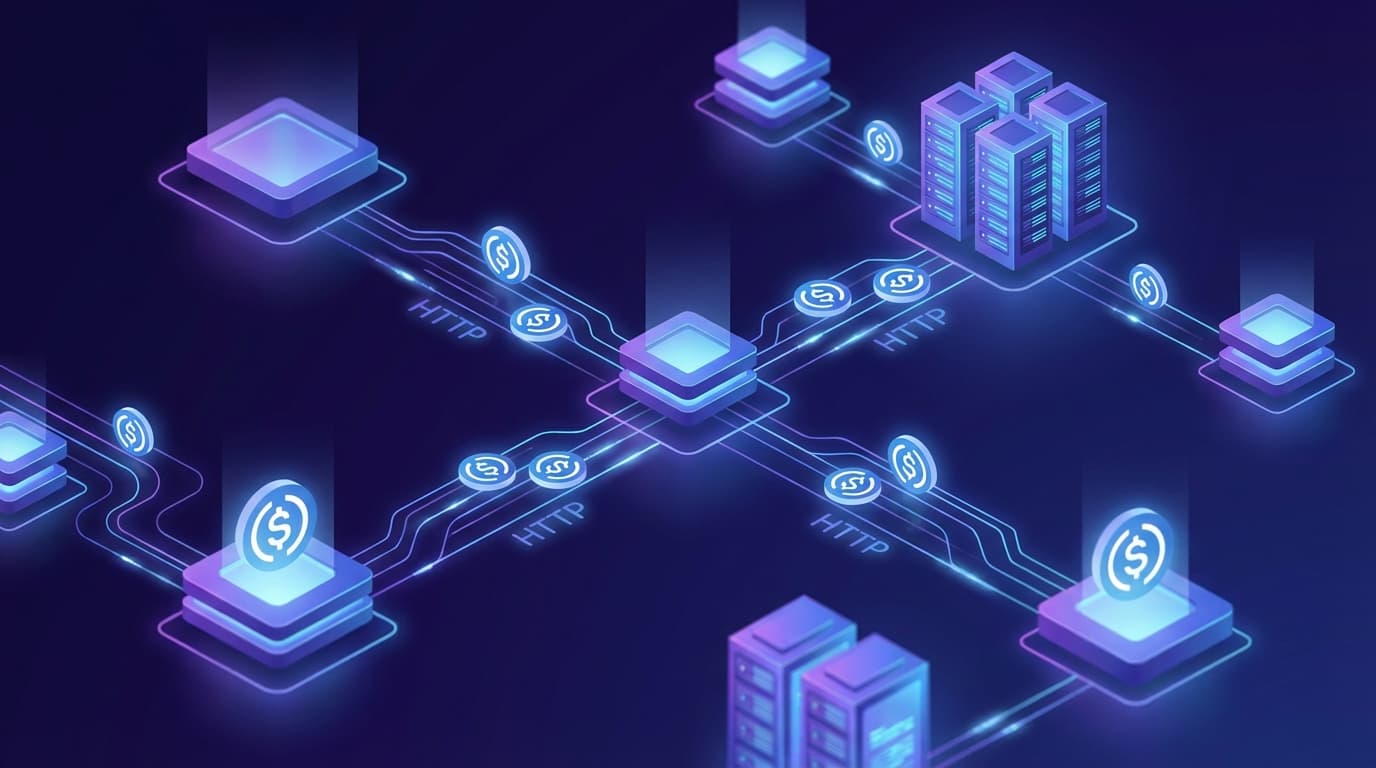
x402 works like this: an AI agent requests a resource from a server. The server responds with HTTP 402 and includes payment instructions, specifying the price, currency (typically USDC), blockchain network, and destination wallet. The agent authorizes payment on-chain, resubmits the request with proof of payment, and receives access. The entire process completes in under a second.
No accounts. No API keys. No subscriptions. Just pay and access.
How It Works Under the Hood
The protocol's architecture has four components that work together:
Clients are AI agents, browsers, or applications making requests. Any software that speaks HTTP can become an x402 client with minimal integration.
Resource servers are standard HTTP servers that gate content or APIs behind a price. Adding x402 support requires only a middleware layer that returns payment metadata on protected endpoints.
Facilitator servers handle payment verification. Coinbase provides a hosted facilitator service that processes stablecoin payments on Base and Solana, so sellers never need to maintain blockchain infrastructure themselves.
The blockchain settlement layer provides final settlement. Base and Solana are the primary networks, with transactions settling in roughly 200 milliseconds at costs below $0.0001 on Layer 2s.
The protocol also supports different payment schemes. "Exact" mode transfers a fixed amount (pay $1 to read an article). A "deferred" scheme proposed by Cloudflare batches multiple micropayments into periodic settlements, potentially supporting millions of transactions per second for high-throughput scenarios like LLM token generation.
35 Million Transactions and Counting
Since launching in May 2025, x402 has processed over 35 million transactions with more than $10 million in volume. The CoinGecko x402 ecosystem category reached roughly $800 million in market capitalization.
Solana has emerged as the dominant settlement layer, handling an estimated 50-80% of all x402 transactions. Its sub-second finality (around 400 milliseconds) and fees below $0.00025 make it a natural fit for micropayments.
Major platforms have integrated the standard. Cloudflare proposed a deferred payment scheme for high-throughput use cases. Vercel supports x402 for serverless function monetization. Google's involvement comes through AP2, a complementary protocol designed to work alongside x402.
The practical applications are straightforward: an AI research agent pays a data provider for real-time market feeds. A content generation agent pays a fact-checking service per query. An autonomous trading bot pays for premium API access on a per-call basis. Each transaction settles instantly without requiring the agent to have an account with the service provider.
The Competitive Landscape: x402, AP2, ACP
x402 is not the only protocol tackling agent payments, but it occupies a specific niche. Here is how the three main approaches compare:
x402 (Coinbase) focuses on crypto-native, pay-per-use HTTP payments. It is open-source, blockchain-settled, and optimized for micropayments between machines. Think of it as the payment rail.
AP2 (Google) is an authorization and orchestration layer. Released under Apache 2.0 with over 60 initial partners including Mastercard, PayPal, and Adyen, AP2 creates a framework for agents to negotiate and authorize payments across different systems. It supports x402 as one of its settlement methods.
ACP (Agentic Commerce Protocol) handles the checkout and merchant integration layer. It is already in production within ChatGPT's checkout flow, managing the last mile of agent-to-merchant transactions.
These protocols are complementary, not competitive. AP2 handles authorization, x402 handles crypto settlement, and ACP handles traditional checkout flows. Together they form a stack that lets AI agents transact across both crypto and fiat systems.
A fourth player, ATXP from an ex-Stripe team, is also building in this space but remains early stage.
For a broader view of how AI agents are reshaping DeFi, the payment infrastructure layer is a critical piece of the puzzle.
Security: The 402Bridge Wake-Up Call
The x402 ecosystem is not without risks. In October 2025, 402Bridge, a cross-chain protocol built on x402, was hacked due to an authorization flaw. Over 200 users lost USDC from their accounts.
A GoPlus Security audit of 30+ x402 ecosystem projects found that the majority had at least one high-risk vulnerability. The most common issues were excessive authorization (contract owners can drain funds), signature replay attacks, honeypot behavior, and unlimited token minting.
The 402Bridge incident specifically exposed several architectural problems: single-key control of critical operations (no multi-signature protection), admin keys stored alongside logs without cold backup, and minimal internal transparency.
Coinbase responded with x402 V2, which introduced five security upgrades targeting the most common vulnerability patterns. But the broader lesson is clear: the protocol standard itself is sound, while many projects building on top of it have shipped without adequate security practices.
This pattern mirrors what happened with early DeFi protocols. The infrastructure works, but the applications need time to mature. Projects like EVMbench are using AI to improve smart contract security, which could eventually help audit x402 ecosystem projects at scale.
The $11 Billion AI Agent Market
The immediate opportunity for x402 is the AI agent economy. The global AI agents market is projected to reach $10.91 billion in 2026 and grow to $183 billion by 2033, according to Grand View Research. Gartner forecasts that 40% of enterprise applications will embed task-specific AI agents by 2026, up from less than 5% in 2025.
These agents will need to make payments. Consider an enterprise AI assistant that books meeting rooms, orders catering, schedules car services, and purchases software licenses on behalf of employees. Each of those transactions currently requires human authorization and traditional payment rails. x402 enables the agent to handle them autonomously with instant settlement and full auditability on-chain.
The broader vision extends to what some call the "machine economy," where autonomous systems transact with each other continuously. Self-driving vehicles paying tolls. IoT sensors purchasing cloud storage. Manufacturing robots ordering replacement parts. Gartner estimates this machine-to-machine economy could reach $30 trillion by 2030.
For context, decentralized AI compute platforms like Bittensor are already building the supply side of this equation, providing the AI infrastructure that agents will pay for using protocols like x402.
What This Means for Crypto
x402 is bullish for several crypto sectors:
Stablecoins are the primary medium of exchange. USDC on Base and Solana handles the settlement, reinforcing the thesis that stablecoins are crypto's killer app for payments. This aligns with the stablecoin market expansion already underway.
Layer 2s and high-performance L1s benefit from being settlement layers. Base (Coinbase's L2) and Solana are the primary beneficiaries today, but the protocol is chain-agnostic by design. Any chain with fast finality and low fees could become an x402 settlement layer.
AI tokens in the x402 ecosystem have seen explosive growth, but investors should exercise caution. The CoinGecko x402 category includes three types of tokens: API tokens that require payment in their native currency, facilitator tokens used for settlement services, and speculative tokens with no real utility. Only projects with real or near-commercialized products are likely to survive long term.
Infrastructure protocols that facilitate cross-chain payments, identity verification, or API monetization stand to benefit as the ecosystem matures.
Investment Risks to Consider
The x402 ecosystem carries several risks that investors should understand:
Speculative token risk: Many tokens claiming association with x402 have no real connection to the protocol. Coinbase has warned that any token claiming to be the "official x402 coin" is likely a scam, as x402 is an open standard with no native token.
Security immaturity: The GoPlus audit findings suggest that many ecosystem projects are shipping fast without adequate security reviews.
Regulatory uncertainty: Autonomous AI payments raise questions about liability, compliance, and anti-money-laundering requirements that regulators have not yet addressed.
Competition from fiat rails: AP2's partnership with Mastercard and PayPal means traditional payment systems are also adapting to serve AI agents. Crypto settlement via x402 may not become the default if fiat alternatives prove sufficient for most use cases.
Disclaimer: This article is for informational purposes only and does not constitute financial advice. Cryptocurrency investments carry significant risk. Always conduct your own research and consult with a qualified financial advisor before making investment decisions.
What to Watch Next
Three developments will determine whether x402 becomes the standard for machine payments:
AP2 integration depth. Google's protocol explicitly supports x402 as a settlement method. If major AP2 partners like Mastercard and PayPal route even a fraction of agent payments through x402, transaction volumes could increase by orders of magnitude.
Enterprise adoption. The transition from developer experimentation to enterprise deployment will be the real test. Watch for announcements from cloud providers integrating x402 into their API monetization tools.
Security maturation. The ecosystem needs more audited, battle-tested implementations. x402 V2 is a step forward, but the 402Bridge incident showed that one major exploit can damage confidence across the entire category.
The HTTP 402 status code waited 29 years for its moment. With AI agents creating billions of dollars in demand for autonomous payments, that moment appears to have arrived. The question is not whether machines will pay each other, but which rails they will use.
For a deeper look at how AI and crypto narratives are converging, read our analysis of AI as crypto's breakout narrative and the cross-chain infrastructure that will connect these payment networks.
Weekly Crypto Insights
Market analysis and actionable insights. No spam, ever.